
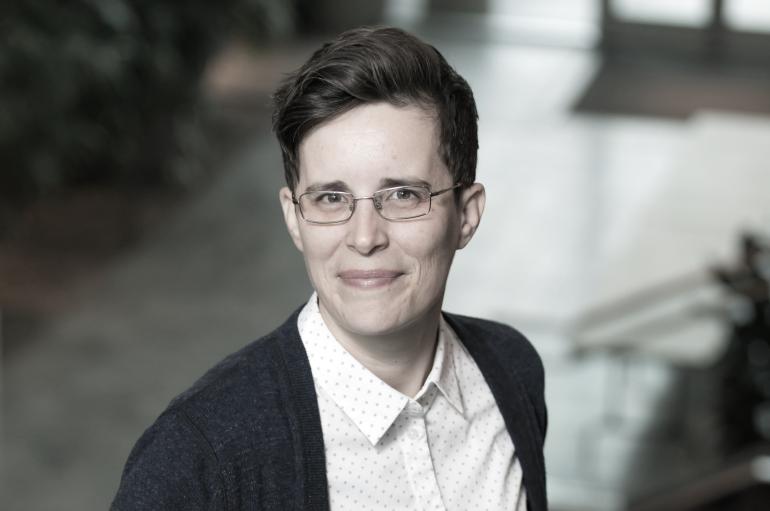
Inés Thiebaut is a composer and Associate Professor of Music at California State University East Bay. Her music is influenced by Greek philosophy, postmodernism, new complexity, and early analog synthesis.
On December 5, 2025, the Grossman Ensemble will premiere Thiebaut's composition apeiron. Learn more about Thiebaut's new piece and experience working with the Grossman Ensemble below.
Much of your music is influenced by your interest in Greek philosophy. What draws you to this subject?
I grew up surrounded by philosophy (my father is a philosopher) so questions about meaning, and the nature of being were part of daily life. I’ve always been drawn to early Greek philosophy in particular, where thought and cosmology were still closely tied to sound, mathematics, and proportion. The notion that music can reflect the structure of the cosmos (Greek Harmonics) and how it relates to both the physical and metaphysical worlds resonate deeply with me as a composer.
How did Greek philosophy influence apeiron?
Greek philosophy shaped apeiron both in its title and in its underlying musical logic. Anaximander’s concept of apeiron (the boundless, the indefinite source from which all things emerge and to which they return) became a powerful metaphor for me as I was composing this piece in the wake of losing my friend, Nicholas R. Nelson. Early Greek philosophy often described the world as a dynamic interplay of opposites, continually transforming, and that idea resonates strongly with my own interest in motion, resonance, and the thresholds between states of being. In apeiron, I tried to create a musical space that feels both generative and dissolving: materials arise, transform, and eventually return to silence.
When you heard the Grossman Ensemble perform your work for the first time, were there any moments that surprised you or uncovered a new layer of the piece?
Yes! I didn't realize the piece was about grief until about half way through the process. At first I started it as an homage to my friend, in the sense of using musical materials and ideas that resonated with him, and the way he thought. But later I realized I was writing from a very different place, a place of loss and the music didn't need to be that cheerful and/or playful.
How has apeiron evolved over the course of the Grossman Ensemble’s workshop process?
I had two main ideas in the first draft that I didn't know how to connect. The first one was a musical depiction of Nick, playful and silly and the gestures felt very fluid. The second idea was opposite, sound moving in time but without much direction. It took a while to figure out they were both a different side of the same piece. By the third rehearsal I had it figured out. It was such a privilege to work in this way and have the time to work out ideas!
What can audiences expect to hear?
In apeiron, I tried to create a musical space that feels both generative and dissolving: materials arise, transform, and eventually return to silence. The blend of acoustic and electronic sound helped me explore this sense of an origin point that is both present and intangible — something infinite, undefined, and yet deeply felt. Not as something finite, but as part of a much larger cycle of becoming and returning.
When you're not composing, what do you like to do in your free time?
Oh, good question. when I am not composing I am most likely teaching, lesson planning, grading, running the studios, and other music department things. I have a wonderful 9-year old, and family time is also very important to me!